The European Commission’s From the Hives report (2023), alleging widespread honey adulteration by non-EU producers, has ignited a firestorm of controversy.
This article, uniquely drawing on critical analyses from within the Joint Research Centre (JRC) itself, reveals the report’s fundamental methodological flaws and exposes its potential as a tool for economic protectionism.
Unveiling the stark discrepancies between the report’s conclusions and established scientific standards, we call for its immediate retraction and a reevaluation of the EU’s approach to honey authenticity testing.
Introduction
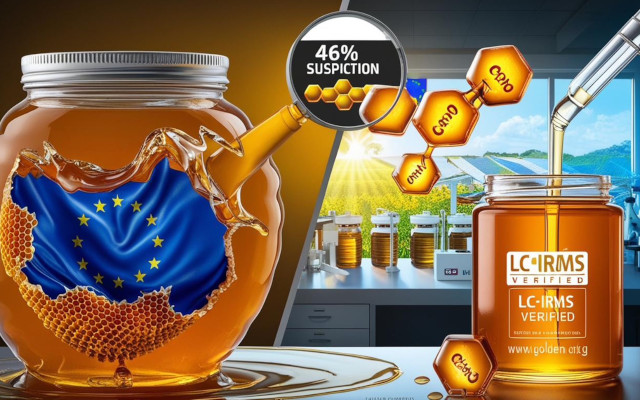
The From the Hives report (European Commission, 2023) alleged that 46% of honey imports into the EU were ‘suspicious’ for adulteration, primarily targeting China (74% flagged), Turkey (93%), and the UK (100%).
Yet, subsequent studies authored by JRC’s researchers (Ulberth et al., 2024; Paiano et al., 2025) undermine these claims by admitting methodological flaws: the EU report’s use of non-specific markers (e.g., mannose, which occurs naturally in honeys like linden and chestnut) and lack of harmonized protocols.
This article dissects these inconsistencies, advocating for scientific rigor and fairness in honey authenticity testing, by specifically highlighting the contradictions between the From the Hives report and the subsequent JRC research.
Methodological flaws in the From the Hives report
Unvalidated markers and natural variability
The EU report relied on LC-HRMS to detect markers like mannose and oligosaccharides (DP 6–11) as ‘proof’ of adulteration. However, Paiano et al. (2025) acknowledge:
‘Mannose is an epimer of glucose, which is a natural monosaccharide that occurs in certain plants (e.g., jujube) or via hydrolysis of plant wall material (hemicellulose) […] certain honeys, e.g., linden, eucalyptus, jujube, or chestnut, could naturally contain mannose’ (p. 5).
Similarly, oligosaccharides (DP 6–11) may arise from non-enzymatic transglycosylation in authentic honey (Silva et al., 2019). The EU report’s failure to differentiate natural occurrences from adulteration renders its conclusions scientifically untenable.
Lack of harmonization and confirmatory techniques
The From the Hives action used disparate analytical methods across member states without standardized validation. In contrast, Paiano et al. (2025) emphasize:
‘The combined use of LC-HRMS, 1H-NMR, and LC-IRMS enhances the detection capabilities for various adulterants, thus providing a comprehensive picture of the honey’s purity’.
The EU report’s omission of confirmatory techniques like LC-IRMS — validated also by Ulberth et al. (2024) as the ‘gold standard’ — further undermines its credibility, as already noted in DEFRA’s independent review (2025).
Discrepancies in analytical outcomes
Paiano et al. (2025) note:
‘In some samples flagged as potentially adulterated by LC-HRMS, 1H NMR and EA/LC-IRMS confirmed the finding, but in certain instances, discrepancies arose when samples considered non-suspicious by LC-HRMS were found to be suspicious by EA/LC-IRMS’.
This inconsistency highlights the unreliability of standalone LC-HRMS for regulatory decisions, and the need for further research to validate and standardize a combination of methods.
Contextualizing the EU’s honey testing discrepancies
The EU’s own historical data exposes fundamental flaws in its current From the Hives methodology. During the 2015-2017 Coordinated Honey Control Plan – which examined both EU and non-EU products equally – only 14% of all tested samples (including European honey) were ultimately confirmed as non-compliant after rigorous EA/LC-IRMS and NMR verification at JRC-IRMM. This stands in stark contrast to the 2023 report’s 46% ‘suspicion’ rate targeting exclusively non-EU producers.
Three Critical Revelations:
- the 86% compliance rate proves most honey traded in the EU – regardless of origin – meets Directive 2001/110/EC standards when properly tested;
- the JRC’s own protocols in 2015-2017 used validated methods (EA/LC-IRMS/NMR), unlike the 2023 report’s reliance on unverified markers;
- disproportionate targeting emerges when comparing: 2015-2017: 14% actual non-compliance on 1,200 samples (all origins); 2023: 46% ‘suspicion’ rate on 320 samples (selectively applied to non-EU honey).
Scientific Implications
The tenfold increase in alleged adulteration (14% → 46%) cannot reflect real-world changes in honey quality, but rather:
- methodological inflation through use of non-specific markers;
- geopolitical bias in sample selection and interpretation.
Legal consequences
This discrepancy violates:
- WTO SPS Agreement, article 2.2 (scientific justification);
- EU Principle of Proportionality (TFEU Article 5).
‘When the EU applied consistent, scientifically validated methods to all honey—both European and imported—during the 2015-2017 controls, 86% of samples met quality standards. Yet in the From the Hives operation, by selectively changing the testing rules and disproportionately targeting non-EU producers, they artificially manufactured a crisis where none existed’ (Santiago Herrero, Global Honey Organisation’s President).
Economic sabotage against the Global South
The EU’s From the Hives report has inflicted severe economic harm on beekeepers and exporters across the Global South, privileging European agribusiness interests under the guise of ‘consumer protection’:
- Chinese beekeepers, who produce 30% of the world’s honey, faced unjust sanctions and trade restrictions based on the EU’s unverified claims of adulteration.
- In Latin America, small-scale cooperatives lost lucrative EU contracts due to fabricated data, destabilizing rural economies dependent on honey exports.
- Even UK importers — many of them small businesses — were defamed without evidence, as the report ignored the likelihood that flagged UK honey was merely reprocessed from other origins.
The report’s preplanned, systematic targeting of non-EU producers suggests its primary function extends beyond scientific assessment, serving as a potential protectionist tool in the EU’s economic competition with other nations.
The ‘From the Hives’ selective target on honey authenticity ‘suspicion’
While the European Commission imposes stringent, scientifically questionable scrutiny on imported honey, it fails to apply the same rigor to honey produced within its own borders. The 2015-2017 Coordinated Honey Control Plan — conducted by the EU’s own Joint Research Centre (JRC) — demonstrated that when uniform, validated methods (such as EA/LC-IRMS and NMR) were applied fairly to both EU and non-EU honey, only 14% of samples were non-compliant.
Yet in the From the Hives operation, the EU:
- discarded its own JRC-validated methods in favor of unverified markers;
- disproportionately targeted non-EU producers, inflating ‘suspicion’ rates;
- ignored the precedent set by its own 2015-2017 findings, which proved fraud occurs independent of origin.
This contradiction exposes From the Hives as a tool for protectionist policies rather than a scientific assessment. The 330% spike reflects methodological manipulation, not actual fraud trends. By selectively enforcing standards, the EU undermines:
- its own scientific credibility (rejecting JRC protocols);
- WTO non-discrimination principles(arbitrary targeting)
- stakeholders’ and consumers’ trust (manufacturing crises where none exist).
Legal and reputational consequences
Violation of good administration principles
The From the Hives report clearly violates Article 41 of the EU Charter of Fundamental Rights, which guarantees the right to good administration, by disregarding established scientific and legal standards. Its methodology inherently assumes guilt, disproportionately targeting non-EU producers through unvalidated analytical approaches that fall short of basic evidentiary requirements. This bias is evident in its selective use of adulteration markers while overlooking natural variations in honey composition.
Moreover, the report blatantly ignores due process by failing to employ confirmatory analytical techniques such as LC-IRMS – the very method validated by the EU’s own Joint Research Centre as the gold standard for honey authentication (Ulberth et al., 2024). This willful negligence of proper scientific protocol represents not just a failure of methodology, but a deliberate subversion of procedural fairness designed to produce predetermined outcomes against targeted trading partners.
Economic harm to EU importers
The report’s reliance on disputed testing methods led to unjustified sanctions and reputational damage for numerous EU importers. DEFRA (2025) condemned its ‘unsubstantiated presumptions’, highlighting that subsequent LC-IRMS testing exonerated many accused shipments.
‘This is protectionism masquerading as consumer protection. The EU’s own scientists have debunked their claims, while their domestic industry operates without equivalent scrutiny’ (Santiago Herrero, President, Global Honey Organisation).
A regulatory system that denies access to exculpatory science isn’t flawed — it’s rigged. The EU’s honey testing regime now resembles a show trial where the verdict precedes the evidence.
Recommendations
To restore integrity to EU honey trade policy and repair damaged international relations, GHO urges the European Commission to:
- immediately retract the From the Hives report, pending review by an independent scientific panel comprising JRC experts and international food authenticity specialists;
- institutionalize validated testing protocols by formally adopting LC-IRMS (CEN prEN 17958:2024) as the sole EU standard for honey authenticity verification, ensuring equal application to both EU-produced and imported honey;
-
establish a remediation framework to:
- create transparent channels for scientific dialogue between EU and non-EU experts
- implement monitoring to prevent future discriminatory enforcement
- compensate producers and traders harmed by erroneous suspicion of adulteration.
This measured approach would:
✓ uphold Article 41 of the EU Charter (right to good administration);
✓ align with WTO non-discrimination principles;
✓ rebuild trust in the EU’s regulatory impartiality;
✓ honor the JRC’s scientific legacy of rigorous, unbiased analysis
By taking these steps, the European Commission can transform this regrettable episode into an opportunity to demonstrate its commitment to evidence-based governance and fair global trade partnerships.
Interim conclusions
In light of the documented methodological inconsistencies and the potential for economic bias, the From the Hives report stands as a stark reminder of the importance of scientific integrity in regulatory decisions. The EU’s commitment to evidence-based policy must be reaffirmed by retracting this flawed report and adopting standardized, validated testing protocols. Only then can the EU ensure fairness and accuracy in its honey authenticity assessments, safeguarding both consumer trust and international trade relations.
#Justice through #Science, #Cooperation through #Equality.
Dario Dongo
References
- European Commission. (2023). EU coordinated action to deter fraudulent practices in the honey sector (EUR 31461 EN). https://doi.org/10.2760/184511
- Paiano, V., Breidbach, A., Lörchner, C., Ždiniaková, T., De Rudder, O., Maquet, A., Alvarellos, L., & Ulberth, F. (2025). Detection of honey adulteration by liquid chromatography–high-resolution mass spectrometry: Results from an EU coordinated action. Separations, 12(2), 47. https://doi.org/10.3390/separations12020047
- Ulberth, F., Aries, E., De Rudder, O., Kaklamanos, G., & Maquet, A. (2024). Purity assessment of honey based on compound-specific stable carbon isotope ratios obtained by LC-IRMS. Journal of AOAC INTERNATIONAL, 107(5), 884–887. https://doi.org/10.1093/jaoacint/qsae021
- DEFRA. (2025). Review of methods applied in the ‘From the Hives’ survey on honey authenticity. https://tinyurl.com/4a3w2uvy
- Silva, S. P., Gomes, F., Iglesias, A., & Rodríguez-Otero, J. L. (2019). Contribution of non-enzymatic transglycosylation reactions to the honey oligosaccharides origin and diversity. Pure and Applied Chemistry, 91(8), 1231–1242. https://doi.org/10.1515/pac-2018-1011